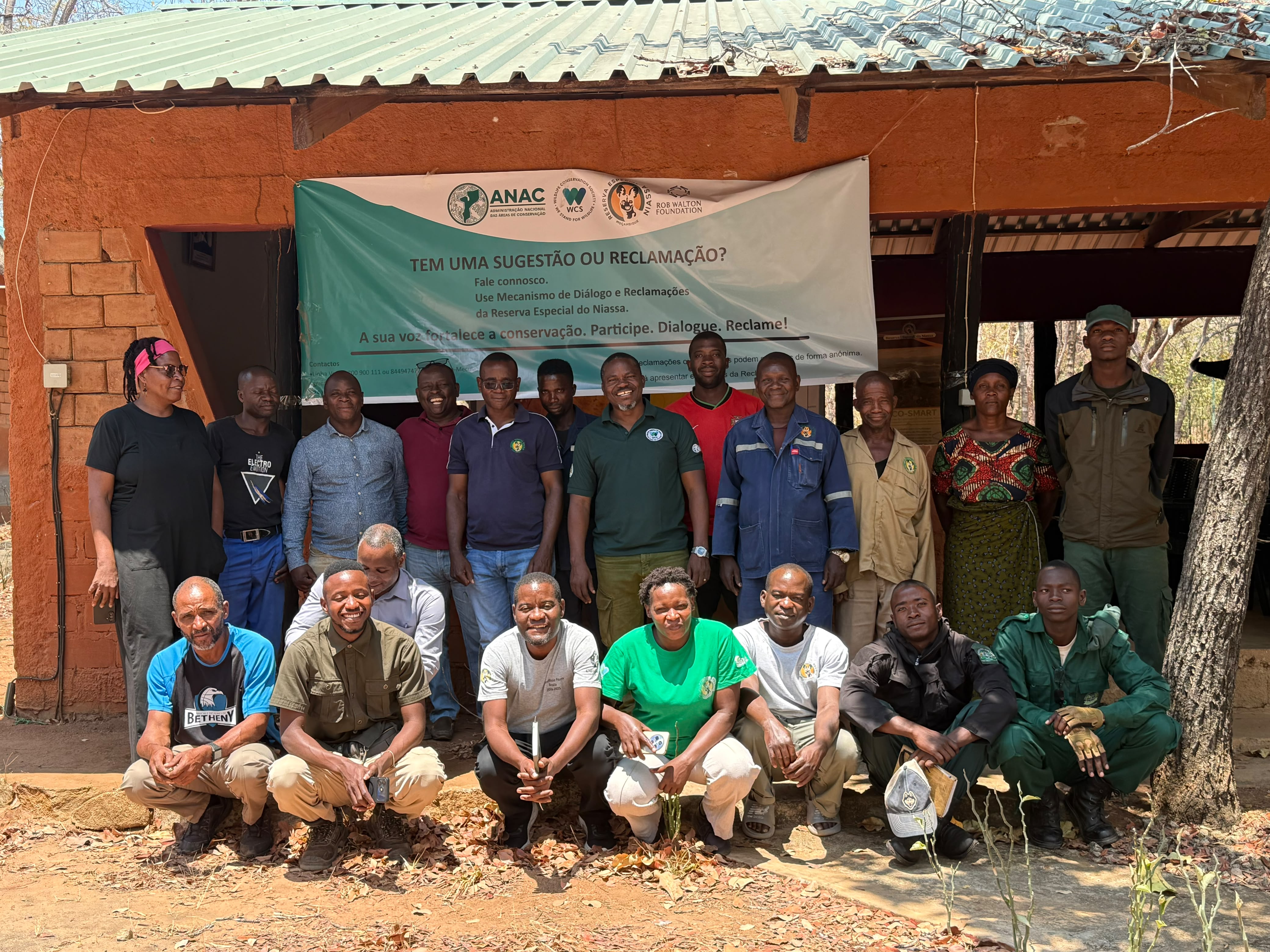
The Wildlife Conservation Society (WCS) Mozambique, in partnership with the Niassa Special Reserve (NSR), conducted a training on Social Safeguards and the Niassa Special Reserve Dialogue and Grievance Mechanism (DGM-NSR) on 21 and 22 September in Mbatamila, Mecula District, Niassa Province. The initiative aimed to strengthen the capacity of conservation teams in managing social risks and promoting more inclusive and participatory engagement with local communities.
The training brought together 69 participants, including 19 women, comprising NSR/WCS technical staff and Protection and Law Enforcement Rangers. The objective was to enhance knowledge and skills on human rights, community rights, participation, social inclusion, and gender equality within the conservation context.
Over the two-day training, participants strengthened their understanding of social risk identification, prevention, and management, including issues related to Gender-Based Violence (GBV), Sexual Exploitation and Abuse (SEA), and Sexual Harassment (SH). The sessions also covered the principles, procedures, and operational framework of the DGM-NSR, a mechanism that provides formal channels for receiving and addressing grievances, concerns, and suggestions from communities and other stakeholders.
The discussions highlighted key principles of the mechanism, including confidentiality, accessibility, non-retaliation, proper referral, and case follow-up, contributing to a more effective, transparent, and inclusive response to concerns raised by stakeholders involved in conservation management.
The training further emphasized the importance of integrating social safeguards into day-to-day conservation and law enforcement activities, ensuring that teams are better equipped to identify risks, prevent negative impacts, and respond appropriately to concerns raised by communities and other stakeholders.
According to Eusébio Celestino, Social Safeguards and Gender Coordinator for the Niassa Special Reserve, strengthening these competencies is essential for promoting stronger and more structured relationships between conservation teams and the communities living within the reserve landscape.
“Strengthening capacities on social safeguards and grievance mechanisms contributes to building dialogue, trust, participation, and respect for human rights, which are fundamental elements for the inclusive and sustainable management of the Niassa Special Reserve,” he said.
The delivery of this training was supported by the Rob Walton Foundation (RWF), which is enabling the continuation of activities initiated through the Northern Mozambique Rural Resilience Project (MozNorte), financed by the World Bank through BIOFUND, and complemented by funding from the European Union (EU).